Circuit Breaker Pattern
Introduction
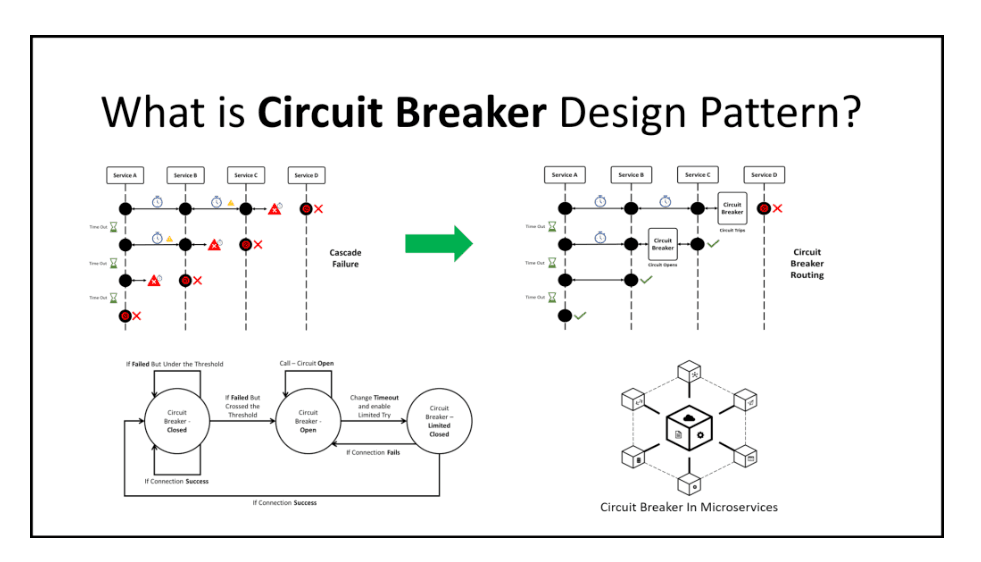
The circuit breaker pattern is a design pattern that improves the resilience of software systems, particularly in distributed environments, by preventing cascading failures. It acts as a protective intermediary between services, monitoring the health of a target service and interrupting calls when the target is likely to fail. This prevents the caller service from repeatedly attempting operations that are likely to fail, thus conserving resources and improving overall system stability.
How it works:
Closed State:
The circuit breaker starts in a closed state, allowing calls to the target service to pass through normally.
Open State:
If the target service experiences a certain number of failures (e.g., timeouts, errors) within a specified time window, the circuit breaker trips and enters the open state. In this state, all subsequent calls to the target service are immediately rejected, and a fallback mechanism or error is returned, preventing further failures.
Half-Open State:
After a set timeout period in the open state, the circuit breaker transitions to the half-open state. In this state, a limited number of test requests are allowed to pass through to the target service. If these test requests succeed, the circuit breaker returns to the closed state. If they fail, it returns to the open state, and the timeout period is reset.
Monitoring and Alerting:
The circuit breaker can also emit events when its state changes, allowing for monitoring and alerting of system issues.
Benefits:
Prevents cascading failures:
By blocking calls to failing services, the circuit breaker prevents a single point of failure from taking down the entire system.
Improves system stability:
Reduces the impact of failures and maintains performance by avoiding unnecessary retries.
Resource optimization:
Conserves resources by not attempting operations that are likely to fail.
Graceful degradation:
Allows for fallback mechanisms or alternative responses when a service is unavailable.
Increased resilience:
Makes the system more robust and better equipped to handle temporary or persistent failures.
Real-world examples:
E-commerce websites:
A payment gateway failing could lead to a circuit breaker switching to an alternative gateway or displaying a message to the user, rather than crashing the entire checkout process.
Streaming services:
If a user preferences service is unavailable, a circuit breaker could serve default or popular content instead of user-specific recommendations.
Conclusion
In essence, the circuit breaker pattern acts as a safety mechanism, protecting the system from the negative effects of failing services and promoting a more stable and resilient overall application.