Introduction to Rancher: Wrangling Kubernetes Clusters at Scale
Introduction to Rancher: Wrangling Kubernetes Clusters at Scale
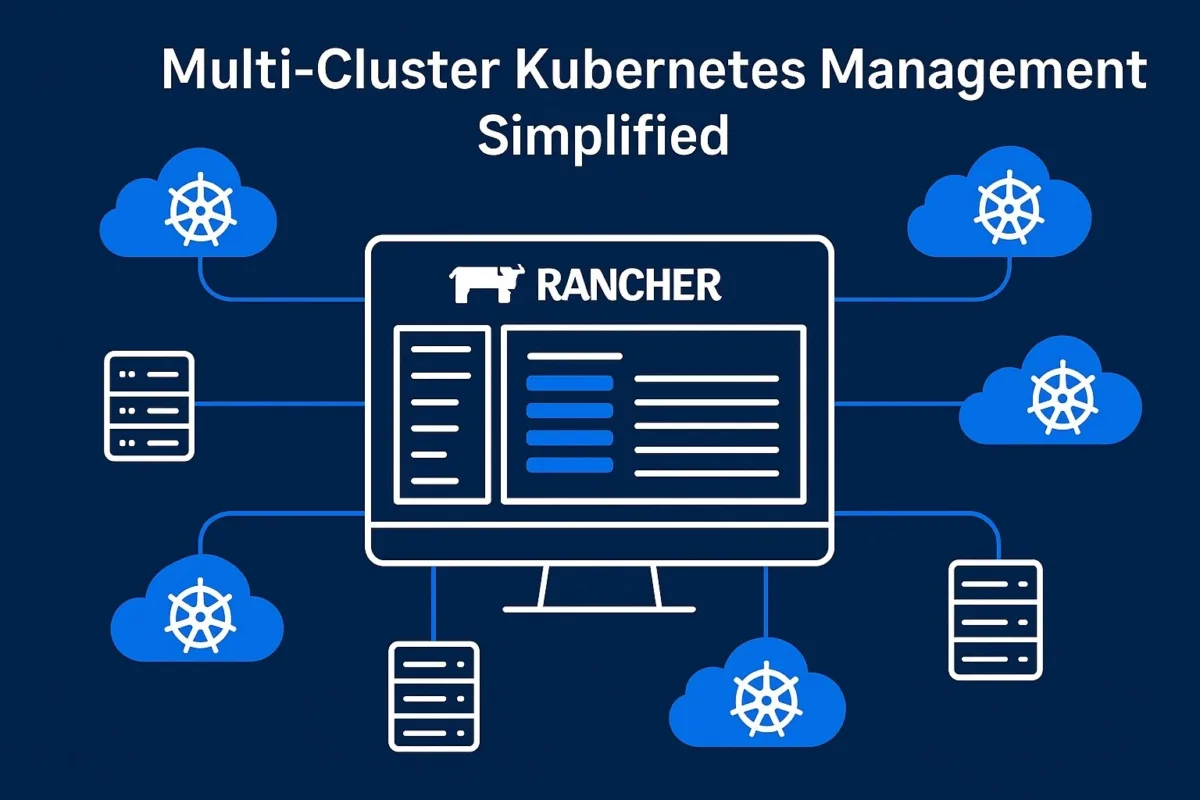
Managing one Kubernetes cluster is a challenge. Managing a dozen of them — across different clouds, data centres, and edge locations — can feel like herding cattle. That's exactly the problem Rancher was built to solve.
What Is Rancher?
Rancher is a free, open-source tool created by Rancher Labs (acquired by SUSE in 2020) that lets you manage multiple Kubernetes clusters from a single place. If Kubernetes orchestrates and deploys containers, then Rancher does the same thing — one level up — for Kubernetes clusters themselves.
It supports clusters running in public clouds (AWS EKS, Azure AKS, Google GKE), on-premises data centres, hybrid environments, and even Internet of Things (IoT) devices. Rancher is also a Cloud Native Computing Foundation (CNCF)-compliant tool, meaning it works with virtually any standard Kubernetes distribution.
The name isn't an accident. There's a well-known saying in cloud infrastructure: "servers are cattle, not pets." When you've got a lot of cattle, you need a rancher to manage the herd.
Why Use Rancher?
The central value proposition is centralised multi-cluster management, but it goes deeper than that:
Multi-cloud and hybrid cloud support — manage all your clusters to a single standard, regardless of where they live.
CNCF compliance — broad compatibility across the Kubernetes ecosystem.
Deep integration with managed Kubernetes services — Rancher can interact directly with cloud provider APIs alongside the Kubernetes API, so you keep the benefits of managed platforms while using Rancher.
Security at scale — implement access controls and compliance policies across every cluster from one console, without micromanaging each one individually.
CI/CD automation — connect Git repositories for automated, Git-based deployments to multiple clusters at once.
Core Features
Rancher's feature set breaks down into four main areas:
1. Cluster Explorer
A GUI console that gives you full visibility into your Kubernetes objects — namespaces, nodes, workloads (CronJobs, DaemonSets, Deployments, StatefulSets, Pods), service discovery, storage objects, and RBAC roles — all in one place. If it's a Kubernetes object, Cluster Explorer will surface it.
2. Continuous Delivery
Rancher's built-in CD tooling connects directly to Git repositories and automates deployments to specific clusters or cluster groups. You can manage Git-based workflows, define workspaces, and keep your delivery pipelines aligned across your entire infrastructure.
3. Apps & Marketplace
Built on Helm charts — YAML-based scripts for deploying complex applications on Kubernetes — the marketplace comes pre-loaded with catalogues for common services like Prometheus, Longhorn, and Nginx. You can also import third-party catalogues or build your own internal catalogue, making it easy for teams to deploy standardised services without reinventing the wheel each time.
4. Security
Rancher integrates with Kubernetes-native RBAC so you can manage user access across all clusters from one console. It supports pod security policies at an organisational level, and authenticates with a wide range of third-party identity providers — including Active Directory, GitHub, Okta, and Keycloak — so you can plug Rancher into whatever your organisation already uses.
The Rancher Ecosystem
Rancher Labs built more than just Rancher. A few closely related tools are worth knowing about:
Rancher Kubernetes Engine (RKE)
RKE is a CNCF-certified Kubernetes distribution that runs entirely inside Docker containers. Rather than manually installing and configuring Kubernetes — a notoriously complex process — RKE wraps that complexity into a straightforward setup that can run on any operating system capable of running Docker, whether bare-metal or virtualised servers.
Key use cases include:
Running Kubernetes in data centres where managed cloud services aren't available
Avoiding vendor lock-in by keeping clusters portable across cloud providers
Maintaining control over underlying infrastructure that managed services typically abstract away
Strict security environments — RKE2 (also called RKE Government) adds compliance with CIS benchmarks and FIPS requirements
K3s
K3s is a lightweight Kubernetes distribution purpose-built for IoT and edge computing. The name is a nod to Kubernetes (abbreviated K8s) — K3s is intentionally smaller.
The entire K3s binary is under 40MB and includes all dependencies needed to get a cluster running. It's optimised for low-compute environments, making it ideal for:
Resource-constrained hardware
Remote sites with limited connectivity (satellite offices, oil rigs)
IoT devices
Running production-grade Kubernetes on something as modest as a Raspberry Pi
K3s was donated by Rancher Labs to the CNCF in 2020 and is now an official CNCF project.
Longhorn
Longhorn is a cloud-native distributed block storage solution for Kubernetes. It tackles one of the trickier challenges in Kubernetes: persistent storage for stateful workloads.
Kubernetes nodes are designed to be ephemeral — they can fail at any moment without taking the cluster down. That's great for stateless workloads, but if you need data to persist, storing it only on a node that might disappear is a problem. Longhorn addresses this by replicating data across multiple nodes, so if one goes down, the data remains available.
Its advantages include cloud-native integration (backing up data to object storage, cross-availability zone failover), resilience (backup clusters separate from primary), and ease of use (one-click installation, live upgrades without downtime).
A Quick Tour of the Console

In practice, Rancher's interface is straightforward. From the main dashboard you can see all clusters under management at a glance. The Cluster Manager view gives you high-level cluster health and metadata, while Cluster Explorer lets you drill into the granular details of every Kubernetes object.
Continuous Delivery is accessible from the same navigation, where you paste in a Git repo URL, define the branches to watch, and configure deployment targets. Apps & Marketplace sits alongside it, offering a searchable catalogue of Helm charts ready to deploy with a few clicks. Security settings — authentication providers, user roles, and pod security policies — live under the Global section of the Cluster Manager.
Use Cases at a Glance
| Scenario | How Rancher Helps |
|---|---|
| Large enterprise with multiple teams | Central shared services team manages all clusters; app teams keep their own |
| Multi-cloud or hybrid cloud | Unified management and standardisation across all environments |
| Strict compliance requirements | Organisation-wide pod security policies without manual cluster-by-cluster work |
| Edge and IoT deployments | K3s runs lightweight clusters on low-power, low-connectivity devices |
| GitOps and CI/CD | Continuous Delivery connects Git repos to automated cluster deployments |
Getting Started
Because Rancher is open source, there's no licensing cost to get started. You can pull the Docker image and have an instance running locally in minutes. The official Rancher documentation is a solid next step, as is the Rancher community Slack for connecting with other users.
If you want to go deeper on the Kubernetes side, resources like the Kubernetes Deep Dive course or the Certified Kubernetes Administrator (CKA) exam preparation materials pair well with this foundation.
Rancher doesn't try to replace Kubernetes — it makes managing it at scale genuinely tractable. Whether you're running two clusters or twenty, across one cloud or five, it's a tool worth having in your infrastructure toolkit.