ACU Utilization on AWS Aurora Serverless
Introduction
Do open connections affect the ACU utilization on aws aurora serverless?
Answer
Yes, open connections can affect the ACU (Aurora Capacity Unit) utilization on AWS Aurora Serverless.
Specifically:
Connection Management and Scaling:
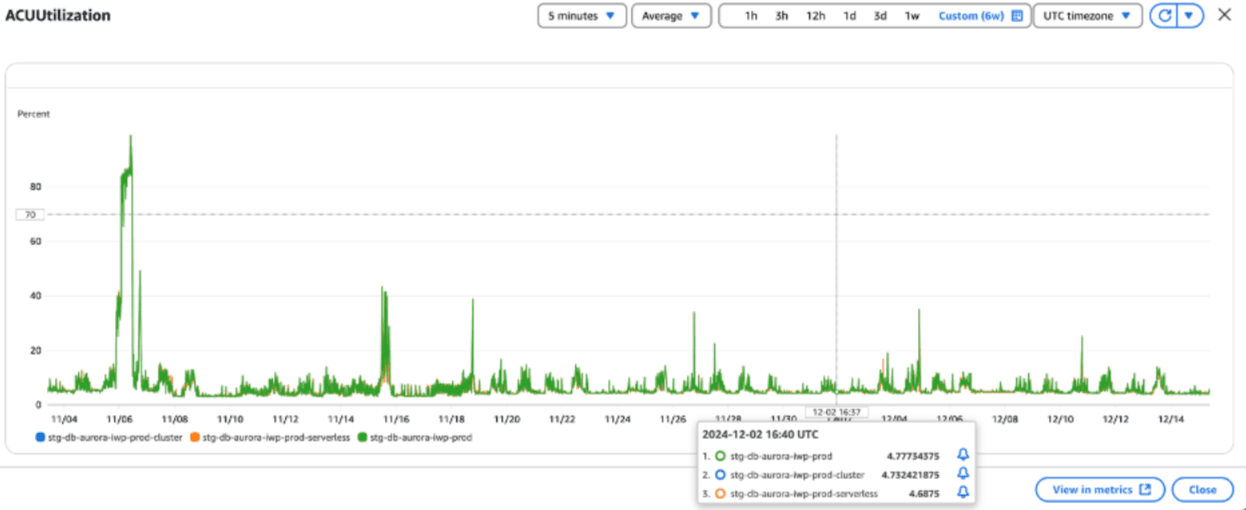
Aurora Serverless v2 scales its capacity (in ACUs) based on the load, which includes CPU utilization, memory usage, network bandwidth, and the number of active connections. A higher number of open connections, even if idle, can contribute to the perceived load and potentially influence the scaling behavior, leading to higher ACU consumption.
Preventing Scale-to-Zero:
For Aurora Serverless v2, if the minimum capacity is set to 0 ACUs, the instance can automatically pause after a period of inactivity. However, any open connections, even idle ones, will prevent the instance from pausing and scaling down to 0 ACUs, incurring compute charges.
Resource Consumption:
Establishing and maintaining database connections consumes resources (compute and memory) on the database server. A large number of open connections, especially if frequently opened and closed by serverless applications without proper connection pooling, can lead to increased resource consumption and potentially higher ACU utilization.
max_connectionsParameter:The
max_connectionsparameter directly impacts the maximum number of concurrent connections allowed. While it doesn't directly dictate ACU usage, if the configuredmax_connectionsvalue necessitates a higher baseline of resources, it can influence the minimum ACU the instance maintains, even during periods of low activity.
Conclusion
For efficient connection management, the use of connection pooling (e.g., with Amazon RDS Proxy or application-level pooling), is crucial for optimizing ACU utilization and cost in Aurora Serverless environments, particularly for workloads with fluctuating connection demands.